Samsung shows off its smart glasses with Google AI
Samsung showed the design of its smart glasses made with Google, featuring integrated Gemini AI. Understand how artificial intelligence is leaving the screen and landing on your face.
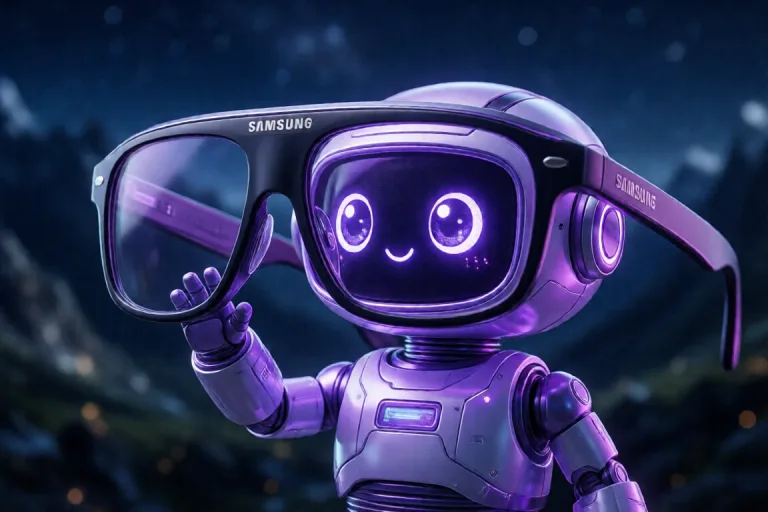
Illustration: FayAI Studio
Samsung revealed what its smart glasses will look like, developed in partnership with Google and fashion brands Gentle Monster and Warby Parker. The idea is for the glasses to look like real glasses — lightweight and stylish — but with a camera, microphone, speakers, and the integrated Gemini artificial intelligence, capable of seeing and hearing what's around you to answer questions and perform tasks.

The announcement is part of a new race among tech giants: after the smartphone, the next stage for artificial intelligence is wearable devices, which you wear on your body all day. Meta already sells its Ray-Ban glasses with AI, and now Samsung and Google enter the fray together with the Android XR system. The bet is that talking to an assistant that sees what you see is more natural than typing on a screen.
For those following AI in Brazil, the news shows a concrete behavioral shift: artificial intelligence is leaving the browser and the chat app to become a constant companion. This opens up uses ranging from instant translation of signs and menus to real-time help fixing a device, following a recipe, or navigating an unfamiliar city — all without taking your phone out of your pocket.

Imagine a practical example: you're in a supermarket, look at an imported product, and ask aloud if it contains gluten and how much it costs in reais. The glasses see the label, translate, research, and answer in your ear within seconds. For students, field professionals, and people with visual impairments, this type of visual assistant tends to be one of the most transformative applications of AI in the coming years.
The practical advice is to follow the arrival of these devices with curiosity, but without rushing: the first generations tend to be expensive and have limited functions in Brazil, besides raising privacy questions — after all, it's a camera always on someone's face. Watch how price, battery life, and Portuguese support evolve. When these points mature, AI glasses should become a craze around here.
 Original story · image from the sourceRead it on The Verge ↗